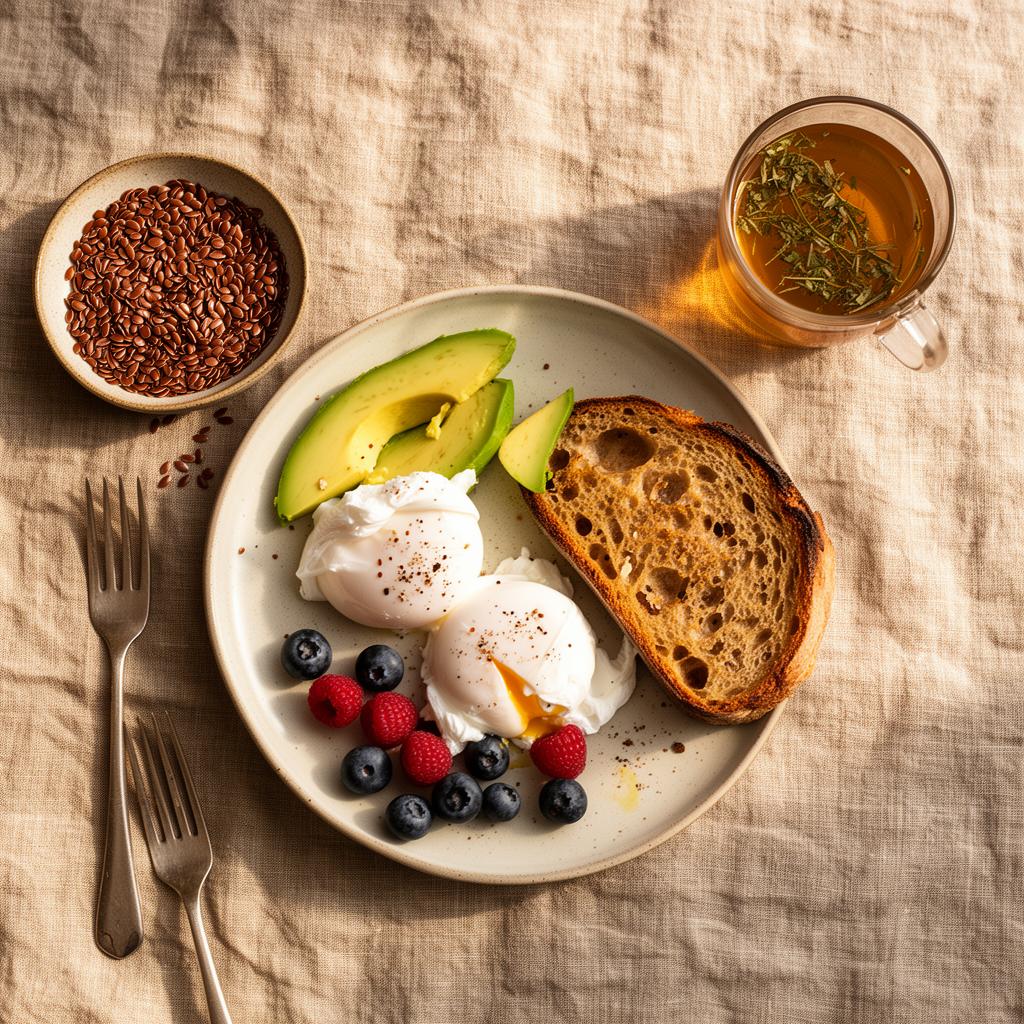
Most women come to hormone work exhausted — already tracking cycles, already cutting seed oils, already wondering why nothing is working. The supplement cupboard is full. The bookshelf is full. The body, somehow, is still tired, still bloated, still cycling unpredictably. The answer is rarely another supplement. It is almost always a foundation that has been neglected: blood sugar, sleep, and the nervous system that quietly runs both.
Start with blood sugar
Stable blood sugar is the single most underrated intervention in women's health. When glucose spikes and crashes throughout the day, the body releases cortisol to bring it back up. Cortisol, in turn, suppresses progesterone, irritates the thyroid, and disrupts ovulation. A 'hormone problem' is, more often than not, a blood sugar problem wearing a different costume.
The corrections are almost embarrassingly simple. Thirty grams of protein at breakfast, within an hour of waking. A short walk after the largest meal of the day. Carbohydrates eaten with fat and fibre, never alone. Caffeine after food, not before. These shifts do more for the menstrual cycle over six months than any adaptogen, because they remove the chronic cortisol load the adrenals have been quietly carrying.
Cycle awareness, not cycle obsession
Knowing roughly where you are in your cycle is useful. Tracking it with such precision that it becomes another job is not. The follicular phase — the first half — tolerates intensity, strength training, and creative output. The luteal phase — the second half — asks for rest, warmth, slower carbohydrates, and earlier nights. The body is not asking you to optimise the cycle. It is asking you to listen to it.
Cycle-syncing apps can be a useful entry point, but if they are making you anxious — if you are afraid to lift weights on day 22 or skip yoga on day 8 — they have stopped serving you. The point is responsiveness, not compliance.
Seed cycling, evidence and honesty
Seed cycling — flax and pumpkin in the follicular phase, sesame and sunflower in the luteal — has weak clinical evidence but a sound nutritional rationale. These seeds are rich in lignans, zinc, magnesium, and vitamin E, all of which support healthy oestrogen metabolism and progesterone production. As a ritual, seed cycling builds the habit of eating real, whole foods on a rhythm. That alone is worth doing. Just don't expect it to substitute for the fundamentals.
Your hormones are not the problem. They are the messenger.
The thyroid no one tested
If you are tired, cold, losing hair, gaining weight inexplicably, and your cycle has gone strange — ask for a full thyroid panel, not just TSH. Free T3, free T4, reverse T3, and thyroid antibodies. Sub-clinical hypothyroidism is one of the most under-diagnosed conditions in women under 40, and standard testing will routinely miss it.
Thyroid recovery is patient work. Selenium, iodine where appropriate, zinc, adequate calories (under-eating is one of the fastest ways to suppress thyroid function), and — again — blood sugar stability. Healing the thyroid without addressing chronic stress is like bailing out a boat without patching the hole.
The quiet rituals
Sunlight in the first hour. Magnesium glycinate before bed. A protein-rich breakfast. Walking after meals. Eight hours of darkness. A wind-down ritual that begins before you are tired. Two strength sessions a week. Food that you would feed to a child you loved. These are the rituals that shift the labs over six months — without burning you out in the process.
Hormone health is not a protocol you bolt onto a chaotic life. It is what emerges when the foundations are quietly in place. Start there.